
A Geological
Timeline of Antarctica
how it became
isolated and cold
Antarctica used to have a tropical climate, it cooled down slowly over many millions of years for three main reasons:
1 - the continent drifted south until it settled over
the South Pole.
2 - carbon dioxide levels globally fell leading
to a general cooling of the planet.
3 - a circumpolar current
arose isolating Antarctica's weather systems from the rest of
the world.
Jurassic Era, 195 -136
Million
Years
Ago -
MYA
Antarctica had been a part of "Gondwanaland" (an ancient super continent that was breaking up and doesn't exist any more) for about 200 million years.
180 MYA
 Gondwanaland
consisting of Africa, Antarctica, Australia,
India and New Zealand begins to
break up
Gondwanaland
consisting of Africa, Antarctica, Australia,
India and New Zealand begins to
break up
Dinosaurs rule the world
and have done for nearly 30 million years
First flowering plants appear.
First mammals and birds appear - but dinosaurs still rule
The South Atlantic is born as Gondwanaland
breaks up
Cretaceous
Era
136 - 65 MYA
100 MYA
 Vast
forests cover Antarctica made up
mainly of huge tree sized ferns and conifers,
most trees that we recognize today are flowering
plants and had only just evolved, they hadn't
got very far yet.
Vast
forests cover Antarctica made up
mainly of huge tree sized ferns and conifers,
most trees that we recognize today are flowering
plants and had only just evolved, they hadn't
got very far yet.
96 MYA
Australia and New Zealand split from Antarctica, Antarctica goes it alone.
 70
MYA
70
MYA
Antarctica enjoys a semi-tropical climate, and continues to drift south.
Rocky mountains rise in North America
First placental mammals - mammals that give birth to live young, earlier ones laid eggs like duck billed platypus and echidnas.
65 MYA an asteroid strikes the earth off the coast of Yucatan, Mexico - some think that this killed off the dinosaurs, others think they were on the way out anyhow. Dinosaurs don't rule anymore - mammals do.
Paleocene 60 MYA

Antarctica develops a cool temperate
climate (like the UK)
Mass extinctions at the end of the
Cretaceous leaves empty niches that the
now dead dinosaurs, giant marine reptiles
and other flora and fauna used to occupy.
Lots of new species evolve to fill these
niches.
Eocene era 54 - 38 MYA
 50
MYA
50
MYA
Much geological activity as the Trans Antarctic mountains are uplifted from sea level cutting across Antarctica from coast to coast.
40 MYA
The first large ice caps form as Antarctica settles its position over the South Pole. This is thought to be partly due to the planet's climate becoming cooler as carbon dioxide level in the atmosphere fall.
First horse like animals, rhinoceroses, ruminants, and the ancestors of elephants.
The first penguins evolve from flying birds.
Oligocene era 38 - 26 MYA
Antarctica accepts the fact that it's a loner and becomes a rugged individualist as the coldest and windiest place on earth.
First monkeys and apes.
First cat and dog families.
Miocene era 26 - 7 MYA
 25
MYA
25
MYA
The whole Antarctic continent
becomes covered in ice.
20 MYA
The Antarctic convergence arises. This circumpolar upwelling of deep oceanic waters essentially isolates the southern ocean from the South Atlantic, Indian and Pacific oceans and has a great effect on keeping Antarctica cold. It also means that many sea creatures cannot migrate north or south across the convergence.
 12
MYA
12
MYA
Seals all over the place.
The first whales evolve
from land-dwelling insectivorous ancestors
Pliocene era 7 - 0 MYA
2 - 5 MYA
Fossilized plant remains found from this period, imply that the ice sheets have advanced and melted back many times over the ages.
4 MYA first Hominids (human like creatures) arise
Homo sapiens, 200,000 years ago? maybe as little as 50,000 years ago
Wandering
Continents
The idea that continents are not fixed in position or size and wander about across the globe is known as Plate Tectonics. It was noticed long ago that the west coast of Africa and east coast of South America fit together quite nicely for instance (ignoring a few thousands of miles of ocean in between). There are many other similarities of rocks and coastlines on different land masses but separated by hundreds or thousands of miles of oceans.

This and other evidence was put into a theory by
a chap called Alfred Wegener in
1912. Like many theories that challenge the accepted
view of things, he wasn't taken seriously at first.

By the 1960's and 1970's however, the theory had
become accepted due to an accumulation
of new evidence about magnetism "frozen" into rock
on the sea floor (terribly complicated stuff - you
don't want to know about it now).

The view is now that the earth is made up of plates,
some are land plates, some are ocean plates. They
fit together like the patches making up a football
- except that there's less of them and they don't
stay in the same place, they wander around over
the football (earth), and they're not all the same
size, and they're bigger than the patches on a football,
and some are land while some are sea (I said that
already). But apart from those things it's
exactly like a football.
Climate change
Scientists are able to find out what the climate was like in different parts of the world in the past mainly through the fossils of plants and animals that are found in the rocks of known age. Corals means the climate was warm, woolly rhinoceros mean that the climate was cold - for instance.

Not as exciting, but plant pollen grains
can give a lot of information about the
types of plants and therefore the climate at various
times in geological history.
Other clever stuff like oxygen isotopes and chemical data found in rocks from lava flows (like a snap-shot at the time it solidified) also add to the picture.

Recent - Now: Antarctica continues to be jolly cold indeed
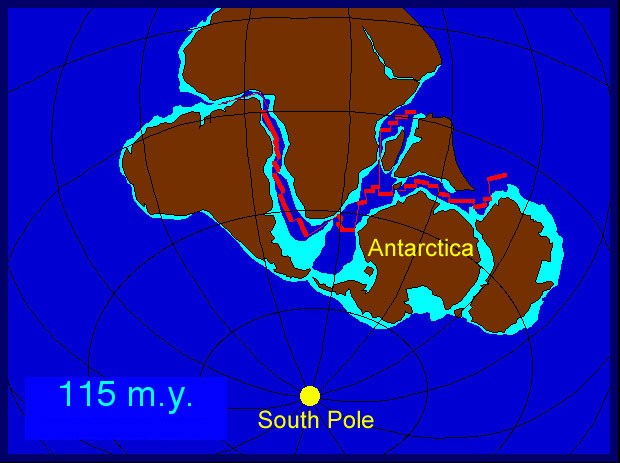
115 million years ago - Cretaceous Era - Dinosaurs rule the world. The Gondwanaland supercontinent is breaking up.
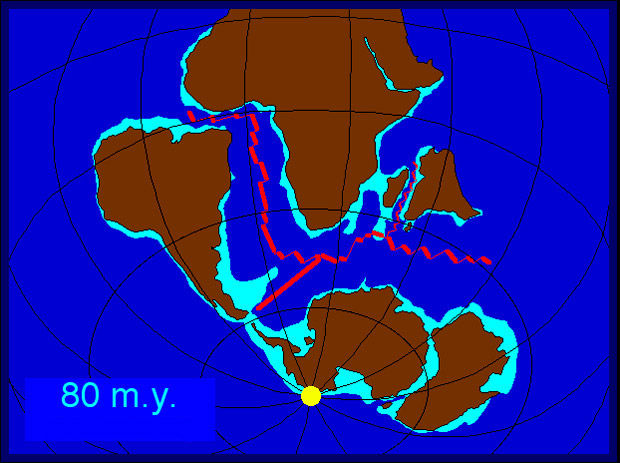
80 million years ago - Cretaceous Era. Antarctica is semi-tropical and covered in forest, outer edge arrives at the South Pole, there is no ice cap.
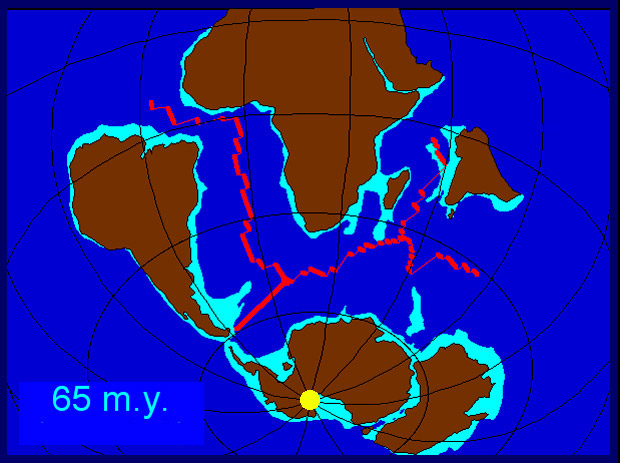
65 million years ago - Cretaceous Era. Dinosaurs die out and mammals begin to take their place. Antarctica continues to drift south and becomes cooler.
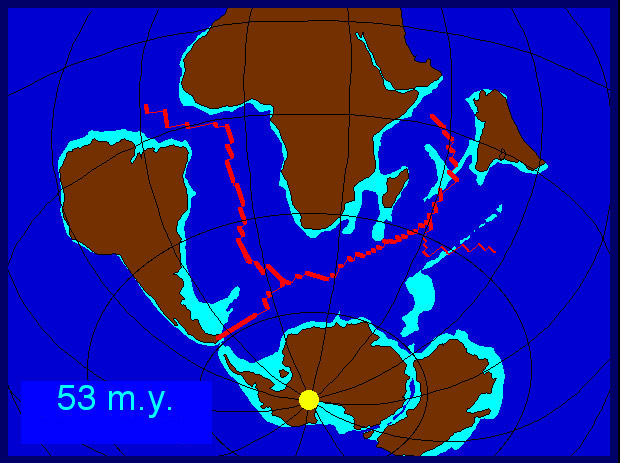
53 million years ago - Eocene Era. Antarctica begins to be isolated, Trans-Antarctic Mountains uplifted.
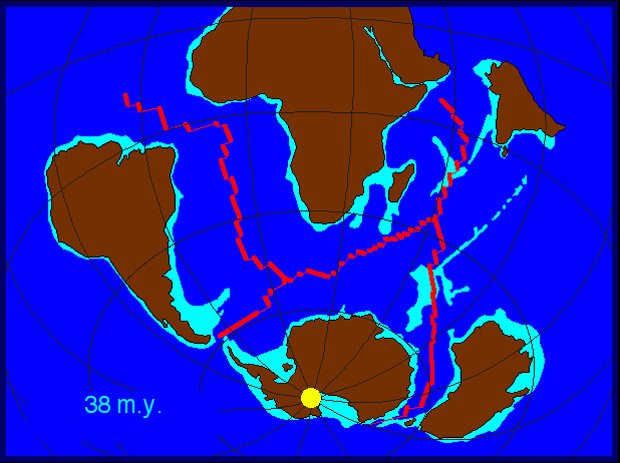
38 million years ago - Oligocene Era. Antarctica settles over the pole, ice cap starts to form, first penguins evolve.
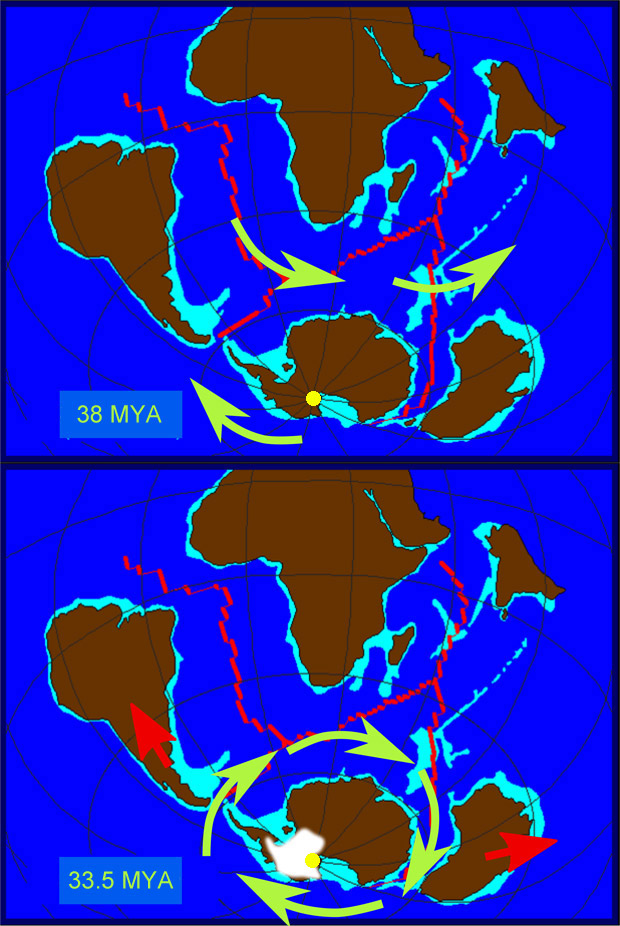
As Antarctica separated from the other land masses the Antarctic Circumpolar Current arose which caused the continental weather systems to become more isolated from the rest of the world, the temperature continued to fall and an ice cap began to grow.
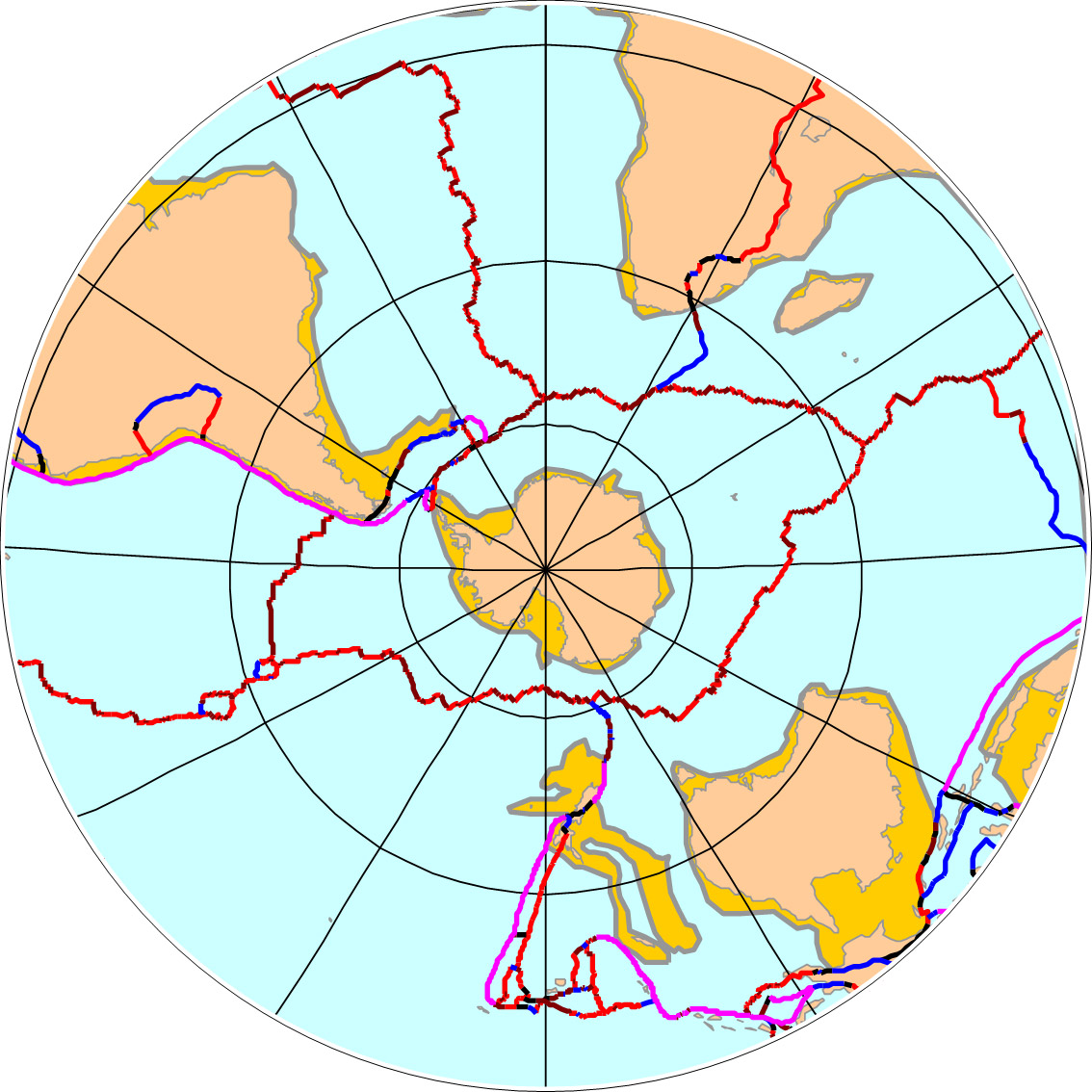
The Southern Hemisphere today showing the edges of tectonic
plate boundaries in red
and Antarctica over the South
Pole.
Picture credits: Gondwanaland break-up series - Hannes Grobe and AWI used under Creative Commons 3.0 Attribution Unported licence. / Circumpolar current image - Jcwf used under Creative Commons 4.0 Attribution, Share Alike International licence. / Modern map with plate boundaries - Micheletb used under Creative Commons 3.0 Attribution, Share Alike Unported licence.