
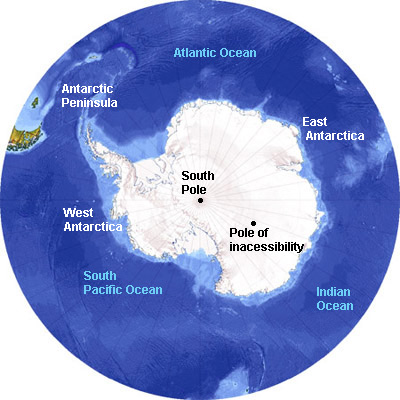
 Antarctica
and Climate Change
Antarctica
and Climate Change
The Effects on Antarctica
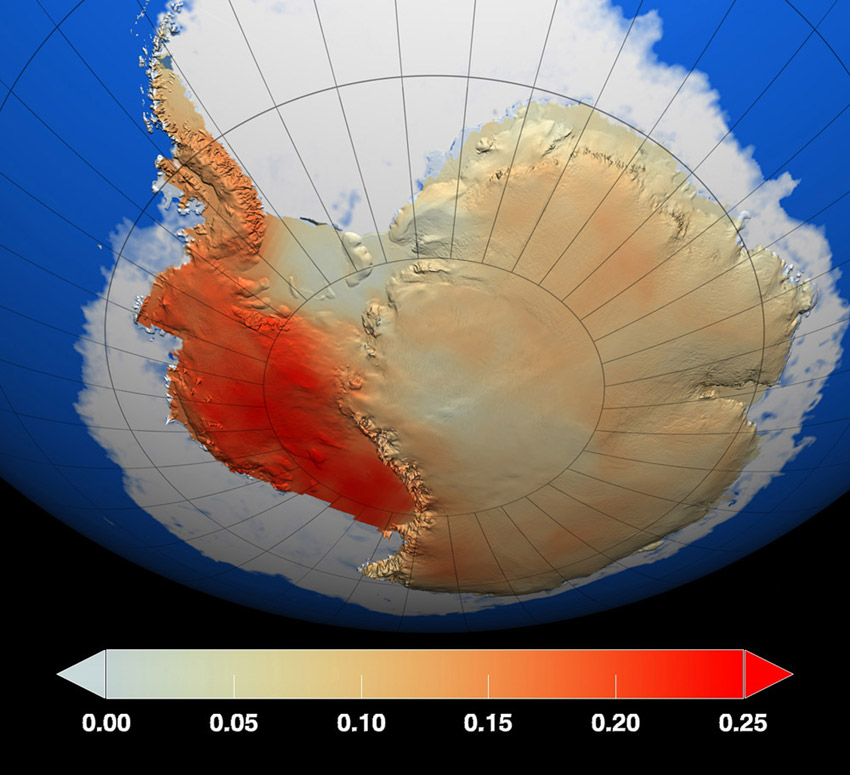
The polar regions are particularly sensitive to small rises in the annual average temperature. The mean annual air temperature of the Antarctic Peninsula has increased by nearly 3°C in the region in the last 50 years, five times the global mean, the only comparable regions are in the Arctic. The temperature of the rest of Antarctica shows indications of rising at a slower rate.
Connected pages: climate change facts and overview | climate change misconceptions | save the poles from climate change
 Temperature
change in Antarctic per decade from 1957-2008 - NASA,
2009
Temperature
change in Antarctic per decade from 1957-2008 - NASA,
2009
For the foreseeable future, climate change in Antarctica
will be a lively topic, the situation is being monitored constantly.
Summary points of this page:
Climate change is real, it is happening more quickly in some parts of the world than others.
The Antarctic Peninsula is particularly sensitive to small rises in the annual average temperature, this has increased by nearly 3°C in the region in the last 50 years, this is about 10 times faster than the average in the rest of the world. This makes it an excellent study area.
The temperature of Western Antarctica has also risen by a comparable amount, this is the region attached to the Peninsula and stretches to the Transantarctic Mountains.
The temperature of Eastern Antarctica has risen by a much smaller amount or has remained stable, this is the region on the other side of the Transantarctic Mountains.
There is no unusual significant loss of ice of any kind from the larger 96% of Antarctica that is not the Peninsula.
Rising temperatures cause ice shelves to break up - as they are floating already this will not affect sea levels, it may cause the glaciers behind them to speed up their flow-rate considerably. These glaciers will add to sea-level rise if they melt.
The temperature of Antarctica as a whole is predicted to rise by a small amount over the next 50 years. Any increase in the rate of ice melting is expected to be at least partly offset by increased snowfall as a result of the warming.
The extent of annual sea-ice has been changing
in both the Arctic and Antarctic, in both cases
it is explicable in terms of global warming.
Satellites over Antarctica can measure gravity changes which can be used to estimate changes in the ice-cover. This short video shows changes between 2002 and 2016. White shows no change and light blue shows a slight increase in ice cover, generally the center has changed little while the West Antarctic Ice Sheet has seen a significant loss of ice.
The Hottest Temperature in Antarctica on Record
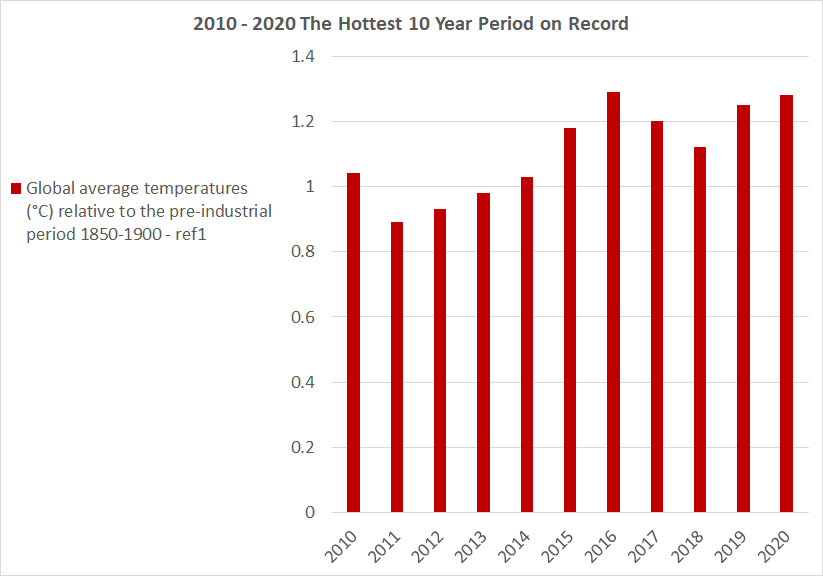
At the time of writing in mid 2021 we have just been through the hottest ten year period on record, the last six have been the hottest six and include the hottest three years on record. The hottest year was both or either of 2016 and 2020 with just a tiny or no difference between them.
On February the 6th 2020, the highest temperature in Antarctica ever recorded was registered at the northern-most tip of the Antarctic Peninsula at the Esperanza Station. The temperature reached 18.3°C (64.9°F) and was the highest in a warm spell that resulted in widespread melting of glaciers in the region. Such melting events caused by temperatures above freezing point for several days were very unusual in the past but have become more common in the 21st century, this high temperature came during the third major melting event of the summer of 2019-2020 in this region. In isolation it wouldn't have been especially notable, however that such events are happening more often is of much greater significance.
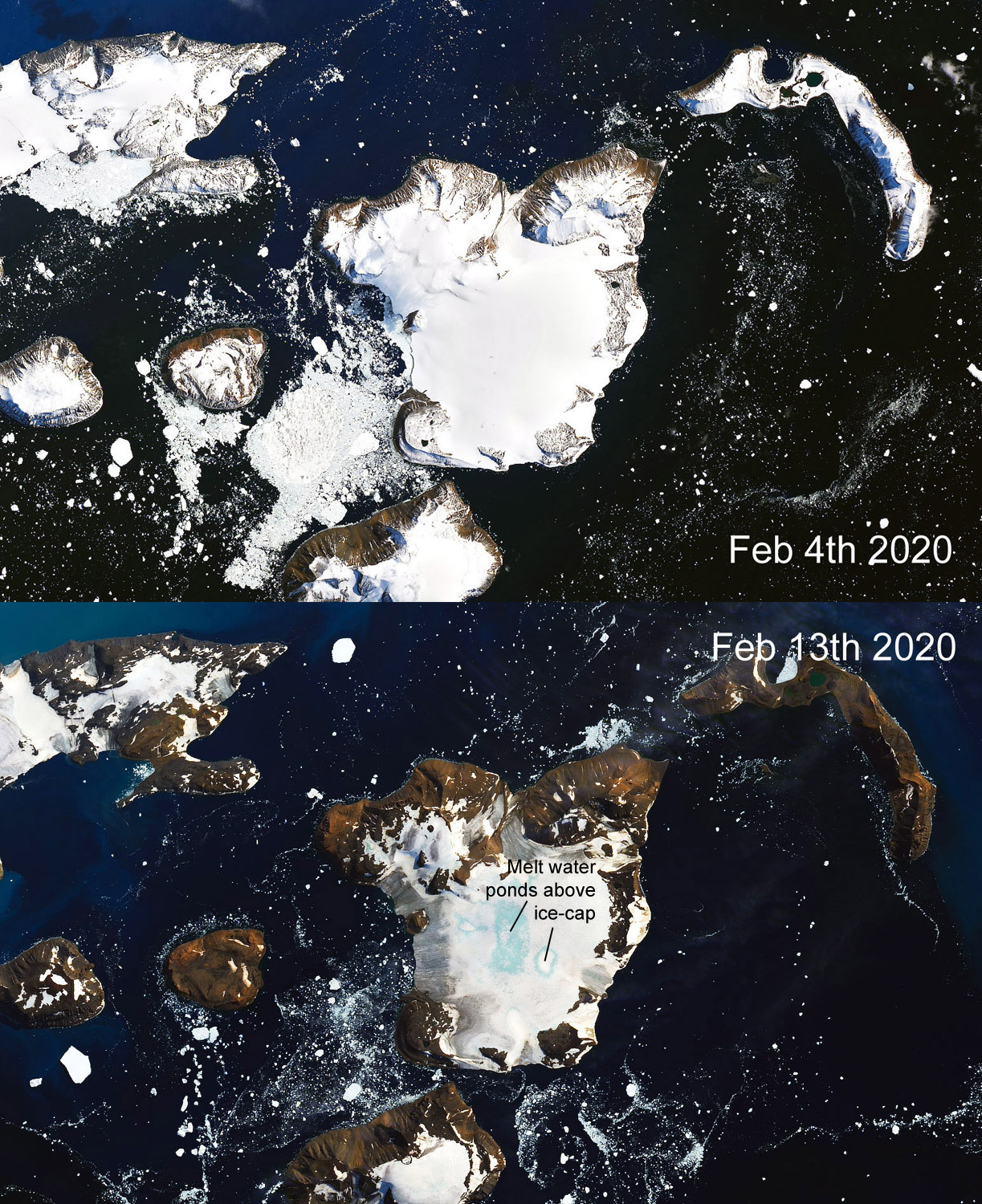
Maps right - Eagle Island at the tip of the peninsula during the melting event in early February 2020, the two images are nine days apart showing significant clearing of seasonal snow but in particular the rapid formation of extensive blue meltwater ponds above the ice-cap. This is something seen more often in the Arctic, but much less commonly in Antarctica.
What evidence is there from ice?
West Antarctic Ice Sheet (WAIS) - a slow motion collapse
The West Antarctic Ice Sheet (to the west of the Antarctic Peninsula) has thinned significantly as a result of warmer temperatures in the surrounding Antarctic Ocean. The upper ocean in this region has increased in temperature by more than 1°C since 1955. The greatest degree of thinning has happened in an area called the Amundsen Sea Embayment.
Many glaciers have retreated and 10 ice shelves have been seen to retreat in recent years. 87% of glaciers along the west coast of the Antarctic Peninsula have retreated in the last 50 years with most of these showing accelerated retreat in the last 20 years.
Fairly recently (May 2014) it has been revealed that the WAIS is collapsing, an event that seems to be unstoppable. It will take a very long time to happen however, several centuries or perhaps up to 1,000 years.
The key area is the Thwaites Glacier, 182,000 square km (70,000 sq miles), almost the same size as Great Britain, which is being undercut by warmer water from the Amundsen Sea resulting in its retreat. It was losing about 10 billions tonnes of ice a year in the 1990's, by 2020 this rate was up to about 80 billion tonnes a year, currently approximately 4% of the annual rise in global sea-levels. The warmer water undercutting it is being driven by changes in wind patterns in this part of Antarctica. The collapse of the Thwaites Glacier alone could lead to a 65cm (2ft) rise in global sea levels, though the biggest effect is likely to come from it acting as an "ice dam" a sort of cork in a bottle of the rest of the WAIS behind it. This could lead to another 3-4m (10-13ft) rise in sea level as the ice previously held in place can move down to the sea.
The collapse of the glacier and rise in sea levels is thought to progress slowly for about two hundred years, but then it probably will speed up considerably. It is thought that there may be two stable states for the WAIS, as it is at the moment (or rather as it was about 50 years ago) and then for it not to be there at all, currently it is undergoing a change between the two states. From 1992 to 2011, the Thwaites Glacier retreated around 14 km, faster than anywhere else in Antarctica.
The end result of this is the possibility that we have already been committed to a rise in global sea levels by 3m or more over the coming centuries.
The Larsen B Ice Shelf
The break-up of the Larsen B ice shelf in early 2002, this event was attributed at the time to the effects of global warming, though it wasn't certain if this was the case. That it occurred was beyond dispute and that it was a result of the warming of the Antarctic Peninsula where it is situated is also beyond dispute. What was unclear at the time was whether or not this was a taste of things to come and an indicator of an Antarctic-wide phenomena or simply a localized result of the localized warming of the Antarctic Peninsula region alone. Subsequent events and temperature records imply it was an early climate change event.
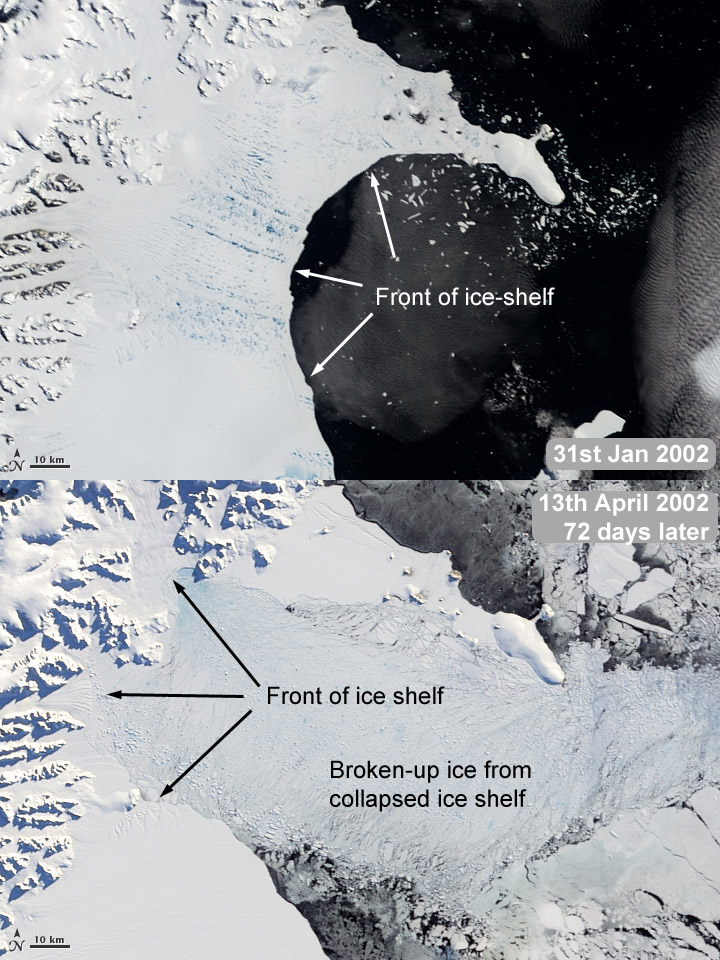
An ice shelf is a thick layer of ice that is floating on the sea. They are fed from the land by glaciers. Where the ice leaves the land and starts to float on the sea is a region known as the "hinge zone" where the ice is particularly chaotic due to cracks, broken-up and a nightmare to try and travel over. Ice shelves surround much of Antarctica.
The Larsen B ice shelf was about 220m thick (720 feet) and during a 35 day period in early 2002 lost about 3,250 km2 of ice into the ocean, such a large area of ice had never been seen to collapse so quickly before. It is thought to have been in existence for at least 400 years prior to this and probably as long as 12,000 years since the end of the last ice age.
Such a disintegration in such a short time period was an extremely significant event. What now remains of the Larsen B is about 40% of what was there in 1995. It had been breaking up at what was considered to be a rapid rate prior to this major event. The break-up is a consequence of higher temperatures and large amounts of summer melt-water running down through crevasses in the ice shelf so speeding the disintegration process.
Overall in the Antarctic Peninsula, seven ice shelves have between them declined in area by about 13,500 km2 since 1974.
A more recently seen phenomena that follows this ice shelf collapse is that the glaciers that fed the ice shelf significantly speeded up their flow down to the sea. The Larsen B glacier behind the ice shelf flowing down from the land increased its speed abruptly by about 300% following this collapse. Combined with the Larsen A ice shelf which underwent a smaller but still enormous collapse of about 1,500 km2 in 1995 the mass loss of ice went from 2-4 gigatonnes per year in the late 1990's to 22-40 gigatonnes in 2006. This deposited much more water in the oceans, and as this was previously on the land added to an increase in sea-level. The Antarctic peninsula doesn't have enough ice to make a catastrophic difference to sea level in itself even if it were all to melt, it is best seen as an indicator region that can be observed to enhance understandings of the mechanisms in other parts of the world.
Arctic and Antarctic Sea Ice
Seasonal sea-ice, that is ice that forms in the winter and disappears in the summer, in Antarctica and the Arctic are both changing though in opposite directions.
-
Arctic sea ice trend, 1978-2021:
average decrease of 13.1% per decade for September minimum, a decrease of 2.6% for wintertime maximum -
Antarctic sea ice trend, 1979-2021:
Almost flat with some short-lived increases or decreases
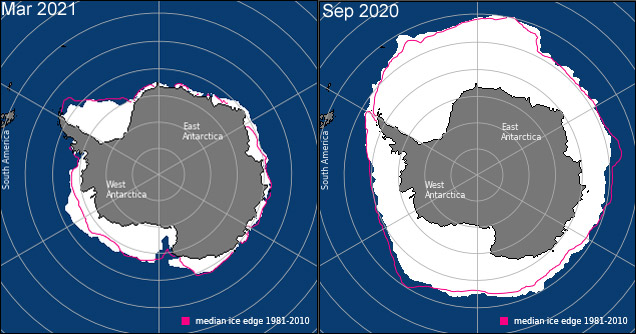
Antarctic sea-ice more than doubles the area of the continent, it rarely last more than a year however and breaks up and melts as it can drift to warmer northern waters.
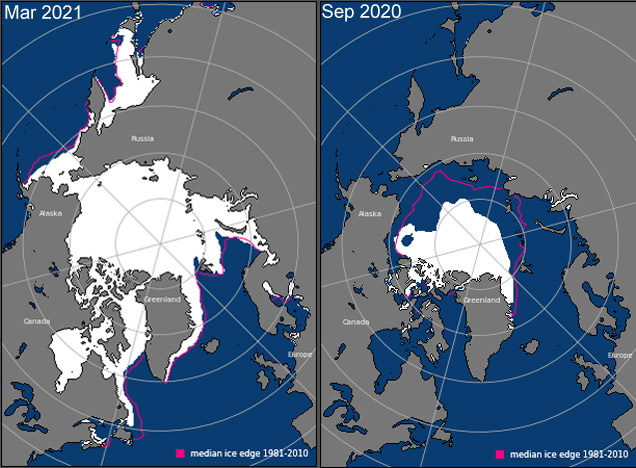
Arctic sea-ice is often more than a year old and so thicker than in the Antarctic, while the winter extent has declined a little in the last 40 years, the summer minimum has declined much more significantly.
Sea ice can build up and disappear much more quickly than the much thicker glaciers and ice shelves, the average thickness in Antarctica is around 1m, in the Arctic it is 2m. Arctic sea ice is more likely to last more than one year and so get thicker, Antarctic sea-ice is more often just a year old before it melts. Glaciers and ice shelves measure in at least 10's of meters and commonly in the 100's of meters.
The area of Arctic sea ice minimum extent
in September 2020 was the second lowest ever measured, 2012
was the lowest. While it may seem that warmer temperatures should
mean less ice in Antarctica, it is explicable, in part by the
effect of the ozone hole that forms annually over Antarctica.
The depletion of the ozone hole has caused an overall
cooling trend on the Antarctic continent, this has
masked the effects of warming temperatures at a local level,
particularly on the larger part of East Antarctica and areas
away from the peninsula region.
The loss of ozone
has also led to increased winds and storms, both in frequency
and strength. Winds in the Southern Ocean have been
estimated to have increased by 15-20%. It has caused a low pressure
system to form in the Amundsen Sea again both with increased
frequency and strength. This low pressure sucks cold air from
the interior of Antarctic and across the Ross Sea leading to
a great increase in the amount of sea-ice forming in this area
in recent years. This has been exacerbated by cold fresh melt
water from the Pine Island glacier, which less dense than the
sea-water below, floats above it freezing more easily than sea
water due to it's lower salt content. The result is that
a combination of more frequent cold storms and more readily
frozen surface sea water leads to more sea ice being formed.
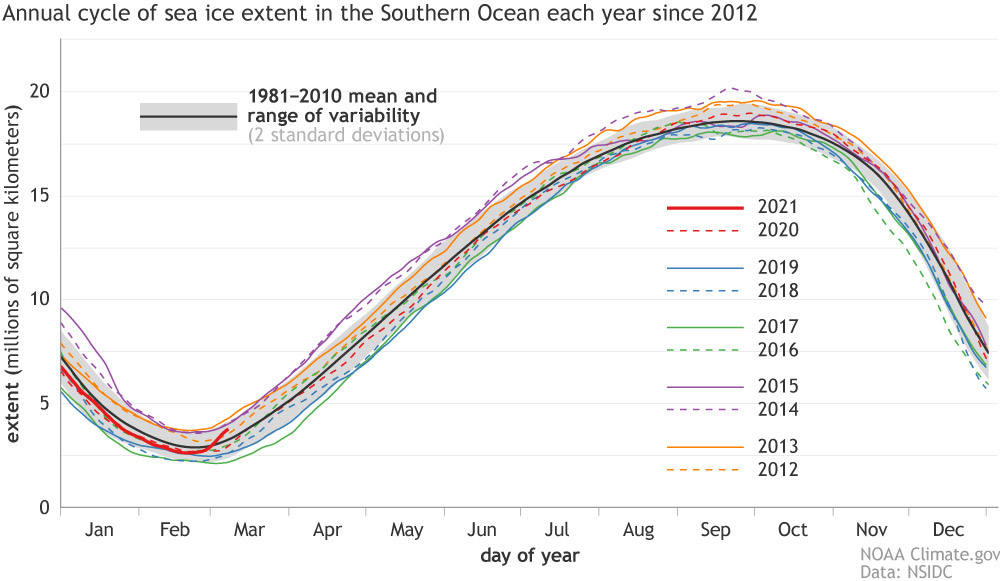
The average extent of sea ice in Antarctica over the last ten years compared to the previous 30 year average.
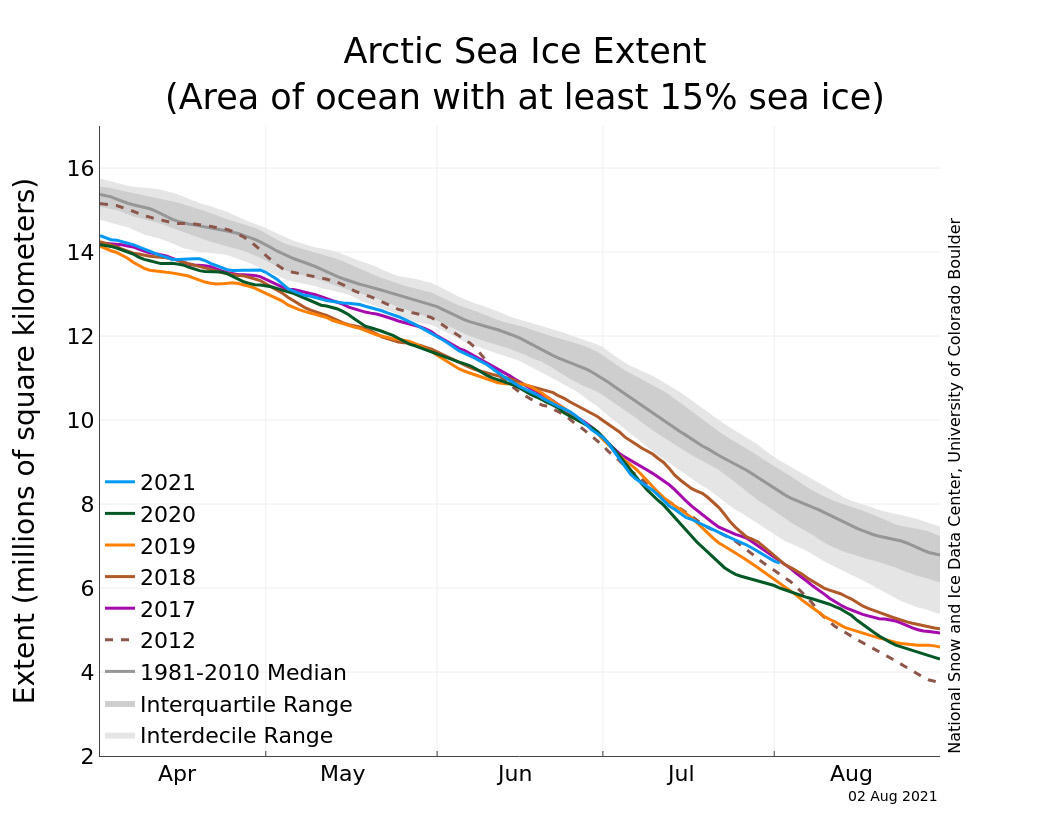
The average extent of sea ice in the Arctic over the last ten years compared to the previous 30 year average.
The two graphs are "opposites" as winter and summer are at different times of the year.
Arctic sea ice cover has declined during the time period while Antarctic has stayed more or less the same, ice cover is more variable from year to year in the Arctic than the Antarctic.
Prince Gustav Channel
The Prince Gustav Channel is a stretch of sea that is found between the Antarctic Peninsula on its west side and James Ross Island at its east side. It is around 130km (81 miles) long and from 6 to 24 km (4-15 miles) wide. Until 1995 an ice shelf covering around 700 square kilometers (270 square miles) largely filled this channel, by February 1995 this ice shelf had broken up and the channel was open water and navigable once again.
Evidence from seabed sediments in areas exposed by the ice shelf break up that had previously been covered showed that it had disappeared at least once before in the last 10,000 years reforming again about 1,900 years ago. The collapse of the ice shelf is evidence of regional climate change and shows that warming in the area is an exceptional event there in at least the last 1,900 years.
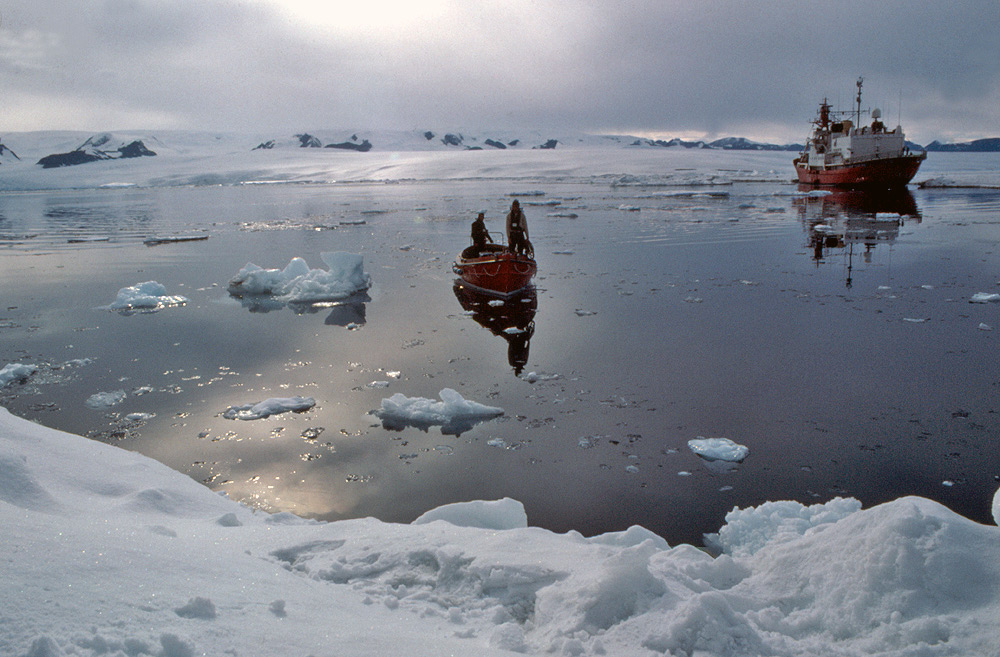
The ice edge of the Prince Gustav Channel where, here
HMS Endurance is moored (1985)
A photograph that may not be able to be taken again for a few hundreds or even thousands of years. In 1985, HMS Endurance is moored up to the ice barrier that blocked the Prince Gustav channel between James Ross Island and the Antarctic Peninsula. Standing by the ship and looking to the left in the picture, the ice slope could be seen to rise to well over 100 feet (30m) altitude into the distance (and 9 to 10 times that thickness under the level of the sea). Today, the whole lot has gone.
Ice Cores
Antarctica has ice that is up to 4700m thick. This ice preserves a record of the conditions at the time it was frozen, of the amounts of gases in the atmosphere and an indication of the temperature. The deeper you drill, the further back in time you go.
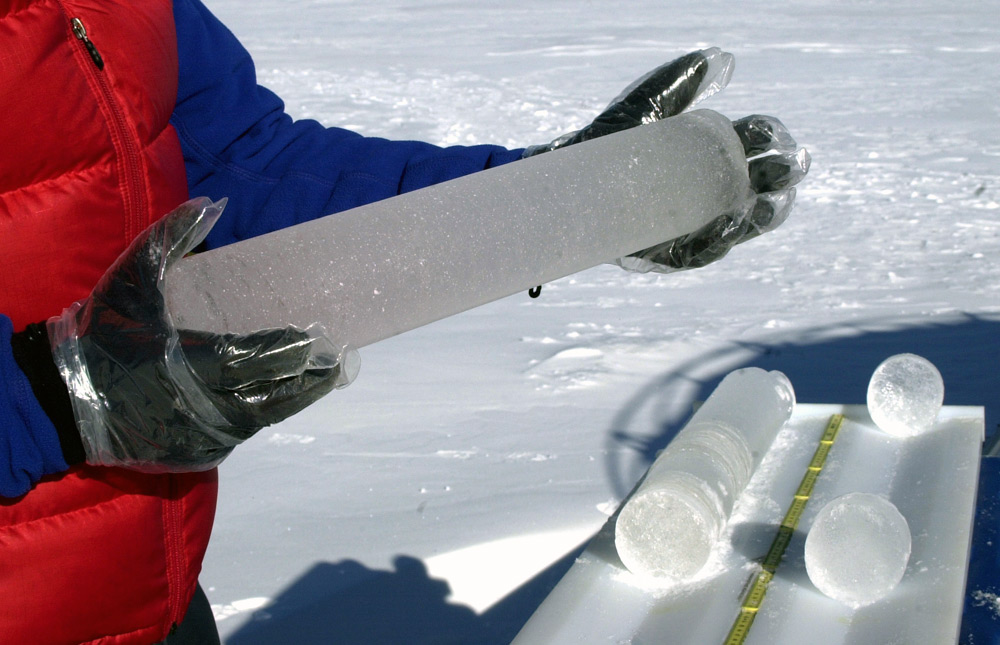
Research into ice cores show that current atmospheric carbon dioxide and methane gas levels (both greenhouse gases) are higher than at any time in the last 800,000 years. The rate of increase of these gases is faster than any likely to have happened in the recent geological past. This 800,000 year record came from a 3km long ice core.
Is the whole of Antarctica warming?
No
The Antarctic Peninsula, particularly the West coast of the Peninsula is warming at a rate about 10 times faster than the global average. This has received a great deal of publicity in recent years and is where the Larsen B ice shelf (see above) is situated. The average annual temperature of this region has increased by nearly 3°C in the last 50 years.
Data on temperatures in Antarctica only really go back about 60 years, anything beyond that is surmised from ice cores or other sources and so we don't accurately know how the temperatures vary over even the medium term in Antarctica. The reason that the Peninsula region appears to be so dramatically warming is that it has a large amount of snow and ice, glaciers, ice shelves and other features, It also has an annual average temperature not far off the freezing point of water. A small increase in the average annual temperature can mean that a few more weeks or even just a few more days per year when melting can occur can result in very visible results on ice features that are more likely to reduce in size or disappear.
The vast majority of Antarctica is so cold that even if the temperature was to rise by the same amount as the Peninsula, there still wouldn't be any melting going on at all. The average surface temperature of continental Antarctica is about -37°C as opposed to -5°C for the warmest places on the peninsula.
Scenario 1 - A 10 degree warmer day
in most of Antarctica still gives a temperature well below
freezing, say -30°C to -20°C
= Nothing
much to see.
Scenario 2 - A 10 degree warmer day
in the Peninsula takes temperatures from say -5C to +5C
= Lots of
melting and potential ice break up, lots to see.
Part of the reason that the Antarctic ice sheet is so cold is that it's so high, due to the thickness of the ice. The melting and flow of the glaciers removing ice from the continent is also slowed by the ice shelves around the continent edge.
Small rises in temperature that start to nibble away a little faster at the edges could eventually speed up the loss of ice from the interior and cause greater temperature rises to take place further inland. Ice shelves seem to act as "corks" in Antarctic "ice-bottles", remove the ice shelf and a huge amount of ice from the interior could start to flow towards the sea where it will melt even though the temperature in the interior may be stable.
The difficulty in trying to predict the future in these matters is that firstly there is not enough data available to base predictions on and secondly, the way things work is not fully understood. Most models from different researchers and teams tend to agree however that there will be some changes in temperature over the next 50 years. It is also expected that the rise in global temperature will put more moisture into the atmosphere and more of this will reach Antarctica so giving a greater snowfall to offset the melting ice to a degree. Despite all the snow and ice there Antarctica is actually classed as a desert as there is so little precipitation, it's just that what does fall stays there so it builds up over a long time period.
Are there any biological effects of global warming in Antarctica?
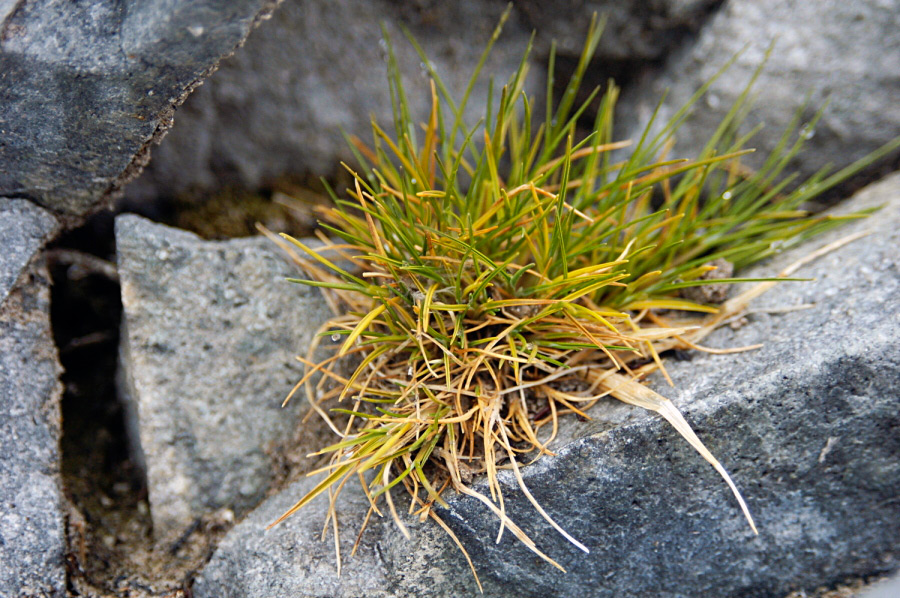 Plants
Antarctica's only two flowering plant species that grow only on the Peninsula have spread considerably in the last few decades in both geographic distribution and also abundance in the areas where they are found. In some areas they are becoming the dominant species. Deschapsia antarctica, Antarctic hair grass shown in picture right.
Part of the reason for this is that there has been a switch from snowfall to rainfall during the summer. This means that more water is available physiologically to the plants rather than being locked up as ice crystals and so unavailable.
Melting ice and permafrost has led to newly available land that has become colonized by plant, animal and microbial communities.
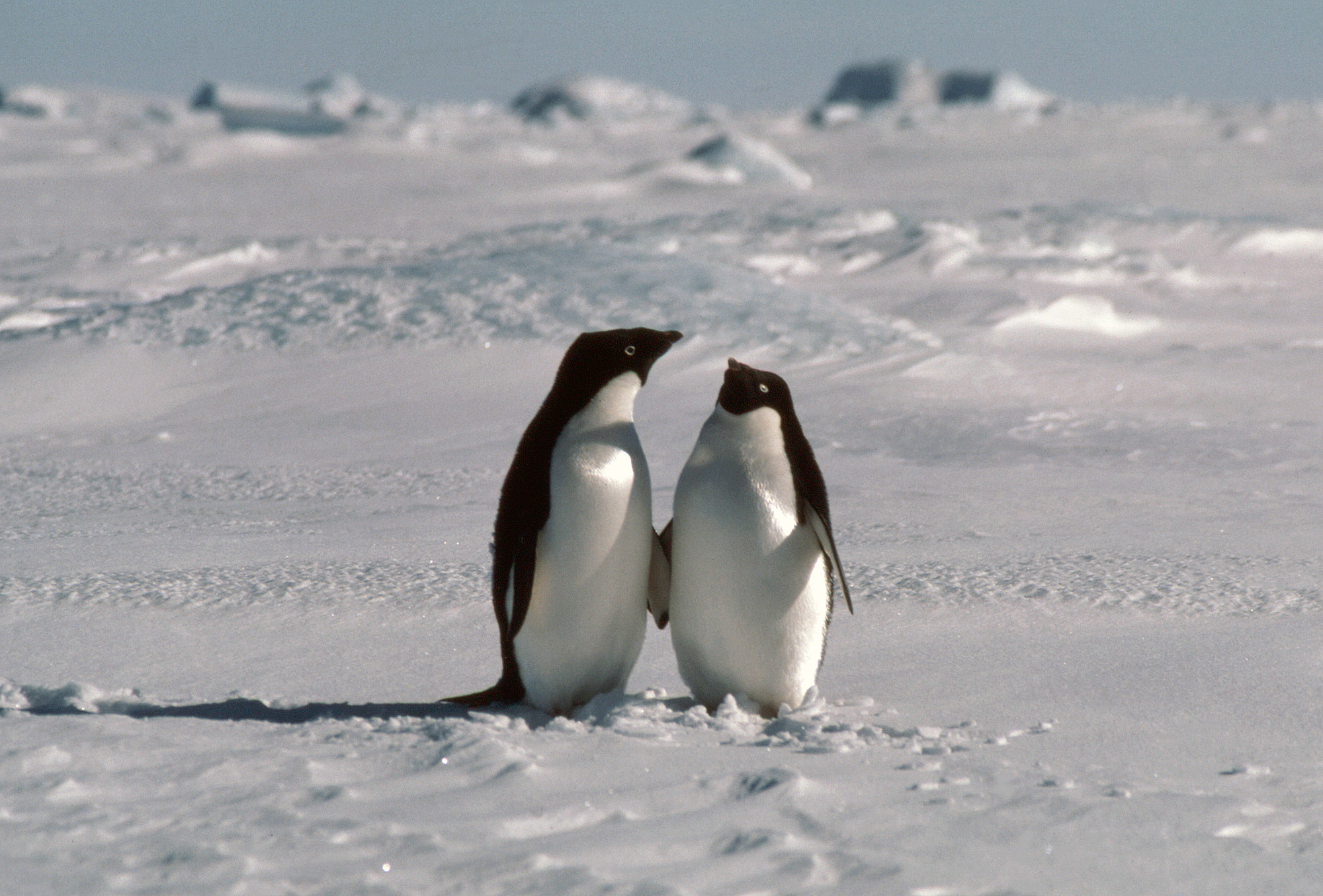
Penguins
Adelie penguins (Pygoscelis adeliae) have also
been suffering a steady decline in parts of the Antarctic Peninsula
region for the last 20 years. Adelies are reducing
in number and abandoning certain nesting sites. Until the last
20 years or so, Chinstrap penguins (Pygoscelis antarctica)
were taking their place. Adelies require pack ice for most of
the year and feed almost exclusively on Krill, Chinstrap penguins
will eat a wider variety of foods and prefer open water. The
sea ice has declined over the last 20 years with the rise in
temperature in the Peninsula region.
More recently however, Gentoo penguins (Pygoscelis papua) have started to replace both Adelie and Chinstrap penguins and now nest on the Peninsula. Studies of the bones and remains found in abandoned colonies indicates that prior to 1950, no Gentoo penguins nested in these sites at all.
Losers - Adelie
and Chinstrap penguins
Winners
- Gentoo penguins
On the other side of Antarctica, the Ross Sea region and East Antarctica, Adelie penguin colonies have remained stable or even increased.
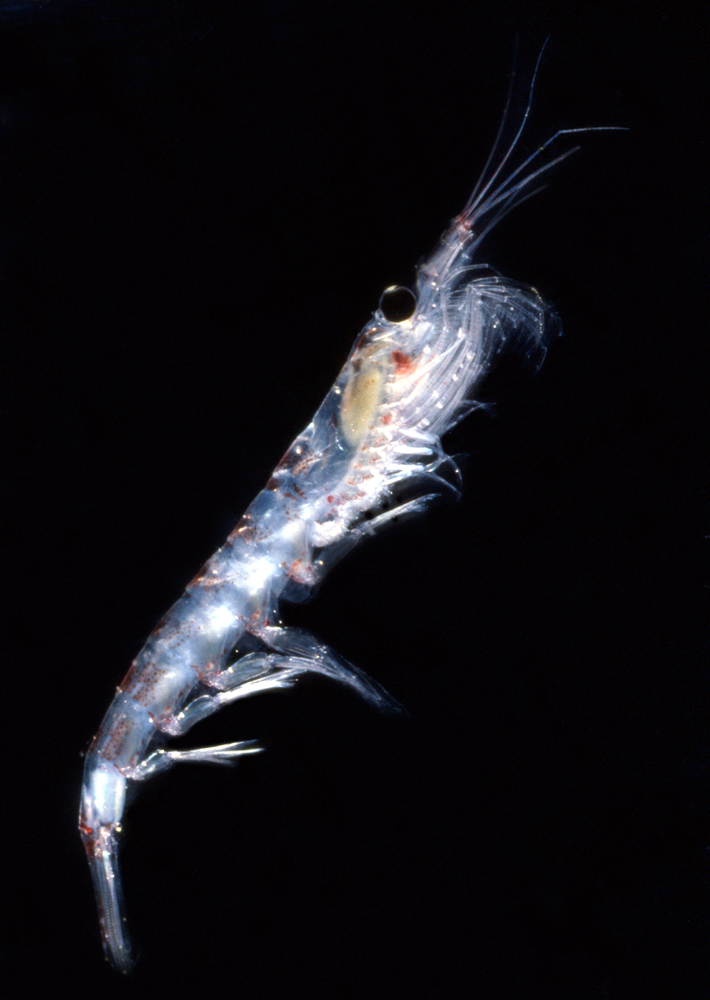
Krill
Studies have shown that stocks of krill in Antarctica have declined dramatically in recent years. The reason for this is likely to be a fall in the amount of sea ice in the winter months in the Antarctic Peninsula region.
Krill numbers in this region may have dropped by as much as 80% since the 1970's - so today's stocks are a mere 1/5th of what they were only 50 years ago. The decline in krill may in turn account for the decline in the numbers of some penguin species.
Dr Angus Atkinson from British Antarctic Survey, says:
"This is the first time that we have understood the full scale of this decline. Krill feed on the algae found under the surface of the sea-ice, which acts as a kind of 'nursery'.
The Antarctic Peninsula, a key breeding ground for the krill, is one of the places in the world where there has been the greatest rise in temperatures due to global warming. This region has warmed by 2.5°C in the last 50 years (much more than the mean global rate), with a striking consequential decrease in winter sea-ice cover.
"We don't fully understand how the loss of sea-ice here is connected to the warming, but we believe that it could be behind the decline in krill."
There are commercial implications as well as scientific ones. The Southern Ocean is a valuable fisheries resource, many of the species caught feed on krill. Thousands of tourists are also attracted to Antarctica to enjoy the spectacular wildlife, most of which feed on krill.
Another animal that feeds on the same phytoplankton
food as krill, jelly-like colonial animals called salps that
drift in the ocean currents have increased in the same time
the krill have decreased.
This decline in krill will
also make it more difficult for the great baleen whales to return
to pre-exploitation levels following their decimation in numbers
during the years from approximately 1925-1975.
Picture credits, copyright pictures used by permission: Arctic and Antarctic sea ice, images and graphs - National Snow and Ice Data Center, University of Colorado, Boulder, Colorado. / Deschampsia antarctica - Lomvi2, used under Creative Commons 3.0 Share and Share Alike Unported license. / Ice core - Emily Stone, NSF / Satellite images - NASA
ref1 - The HadCRUT5 global temperature series, produced by the Met Office,University of East AngliaUK National Centre for Atmospheric Science