
Whales
Biology and Adaptations
Whales are amongst the most enigmatic and fascinating of all creatures. The Blue Whale is the largest animal ever to have lived on earth, at up to 100 tons, easily out-weighing the heaviest dinosaurs, even an "ordinary " sized whale is a vast and impressive creature.
 Whales are huge, but elusive and difficult
to see which adds to their mystery and fascination.
They are highly intelligent animals with an elaborate social
life, no possessions and the complete freedom of movement in
three dimensions. Is it any wonder that they are such popular
and fascinating animals? - maybe we just want to be like them.
Whales are huge, but elusive and difficult
to see which adds to their mystery and fascination.
They are highly intelligent animals with an elaborate social
life, no possessions and the complete freedom of movement in
three dimensions. Is it any wonder that they are such popular
and fascinating animals? - maybe we just want to be like them.
Whales belong to the group of mammals called Cetaceans, they are a part of this group along with dolphins and porpoises.
Whales are mammals as are humans, dogs, cats, elephants and anguantibos amongst others. This means that they are not fish. They breathe air and so must return to the surface at regular intervals to get a breath. They give birth to live young that stay with the mother for over a year and feed on milk produced by the mother.
Whales are warm blooded and have a skeleton similar to our own (though greatly modified) the fore limbs are their front flippers and have similar bones in them to our arms and hands. The hind-limbs are generally not present at all, though are represented in many species by a tiny pair of "free floating" bones (pelvic vestiges) - not attached to any others - towards the rear of the animal. In the males of some species these bones serve as an attachment for the muscles that control the penis (ooh err!)

The rear flippers of a whale are called the flukes, these have no bone in them at all, being made of tough fibrous material. It is the flukes that provide the propulsive power in all Cetaceans with the forelimbs controlling direction and being used for communicative and social functions.
All whales have muscle with a high level of Myoglobin. This is a red pigment similar to haemoglobin that stores oxygen in the muscles for use during deep dives. When the whale surfaces, the oxygen in the myoglobin is replaced, similar to the process that happens in our own muscles during a sprint.
Sperm whale myoglobin was the first ever protein to have its three dimensional structure described in 1957 by the technique of x-ray crystallography which led to the Nobel chemistry prize in 1962 shared by John Kendrew and Max perutz.
Whale adaptations
How are blue, right, fin, sei, humpback, fin whales, the large species found in Antarctica, adapted to survive in the cold oceans?
Whales are not exclusively Antarctic animals but often found in the frigid waters in both north and south polar regions.

Large whales are able to live indefinitely in the coldest seas on earth. If you were to fall into the Antarctic Ocean, you would have about 15 minutes before hypothermia set in, at this point you may pass out and drown, in any case you would be dependent on someone else to get you out of the sea, even if you were kept afloat with a life vest you would be dead in 60-90 minutes. Whales however can live at the same temperatures indefinitely if healthy and reasonably fed, they just don't get hypothermia - ever. The reason for this is that a large size with a low surface area to volume ratio, and a blanket of blubber around the whole animal below the skin mean that metabolic heat is retained to the degree that the coldest seas are readily survivable.
They have a number of adaptations that enable them to live and thrive in the Polar regions, these can be broken down into:
- Anatomical - Structures of the body.
- Behavioural - The manner in which animals move and act.
- Physiological - The internal functions of the animal from biochemical, to cellular, tissue, organ and whole organism levels.
Anatomical Adaptations

 Baleen plates in the mouth instead of teeth to filter food in
bulk from seawater. These are made of keratin, the
same tough protein that makes hair, skin, nails, hooves and
horns. There are two rows of plates that hang down from the
upper jaw forming two upright sides of a triangle with the lower
jaw being the third side. The inner edges of these plates are
bristly filters to collect food, usually smallish very numerous
animals such as krill in the water they gulp in. A huge mouthful
of water + food is taken in and the mouth closed, then the water
is ejected by the tongue while the food is filtered out and
trapped inside the mouth to be swallowed when the water has
gone.
55 - 68 ventral grooves that extend from the lower jaw to the
navel (yes, whales have a belly button!) These allow
a huge amount of water and food to be taken into the mouth allowing
it to expand to about 6 times larger than normal size (sometimes
a bigger volume than the whale itself). The largest whales (blue
whales) can eat up to 4 tonnes of food a day in the Antarctic
summer, they can feed for about 8 months and then fast for 4
months living off their fat reserves.
Baleen plates in the mouth instead of teeth to filter food in
bulk from seawater. These are made of keratin, the
same tough protein that makes hair, skin, nails, hooves and
horns. There are two rows of plates that hang down from the
upper jaw forming two upright sides of a triangle with the lower
jaw being the third side. The inner edges of these plates are
bristly filters to collect food, usually smallish very numerous
animals such as krill in the water they gulp in. A huge mouthful
of water + food is taken in and the mouth closed, then the water
is ejected by the tongue while the food is filtered out and
trapped inside the mouth to be swallowed when the water has
gone.
55 - 68 ventral grooves that extend from the lower jaw to the
navel (yes, whales have a belly button!) These allow
a huge amount of water and food to be taken into the mouth allowing
it to expand to about 6 times larger than normal size (sometimes
a bigger volume than the whale itself). The largest whales (blue
whales) can eat up to 4 tonnes of food a day in the Antarctic
summer, they can feed for about 8 months and then fast for 4
months living off their fat reserves.

Large whales have stretchy nerves in the muscle of the
floor of the mouth to allow for that expansion with water and
food to take place. This might not seem very significant,
but nerves are generally delicate structures and any stretching
will usually cause serious damage. The nerves in this part of
the baleen whale are elastic with a cord limiter to prevent
damage by over-stretching so preserving the still fragile structure
of the neurones that carry impulses to the muscles that expel
the water from feeding.Lunge feeding may be a key development in allowing whales to reach their enormous size, so stretchy nerves could be a vital component in the evolution of large whales.
A ridge in front of the blowholes (the two nostrils) which are
located on top of the head. Pointing backwards means
that they are not filled with water when swimming, being placed
on top of the head makes it easy to breathe while surfacing
and lifting the smallest amount of the body possible, like a
short snorkel.
A huge tail fin the size of two dinner tables that provide the
main propulsion for swimming. The smaller forward fins
are for changing direction and the small dorsal (mid-back) fin
helps with stabilizing straight swimming, it is the tail that
provides the power.Behavioural Adaptations

Bubble netting. A feeding technique practised by humpback
whales, one or two whales dive down below a shoal or swarm of
prey, fish or invertebrates, they then slowly swim vertically
upwards towards the surface in a spiral. They blow bubbles as
they swim which float up in a circle and panic in towards the
centre. The whale/s then dash straight up through the middle
with their mouths open and get a more concentrated mouthful
of food.Other whales may come in at this point too, as the prey flee one predator, they are more likely to blunder into the path of another, so co-operative feeding helps them all.
 Lunge feeding. This is a technique whereby
the whale approaches a concentration of prey in the water and
then lunges at them with its mouth wide open and the floor of
the mouth distended enormously to engulf they prey and a large
volume of water at the same time. The water is then pushed out
over the baleen plates with the food being filtered out, so
it is a sort of batch filtering process. It may be combined
with bubble netting and/or co-operative feeding with other whales
to help concentrate the prey for the most satisfying mouthfuls.
Migration - Many whales migrate to the polar regions during
the summer months of that region. There are often distinct
southern and northern populations of species which go to their
respective pole, none go to both poles. They
feed continuously during the super-productive summer months
and then live entirely on their blubber reserves for about 4
months during the breeding season in warmer waters. Not all
individuals migrate however and in recent years, some humpback
whales have been found around Antarctica during the winter rather
than 7,000km (4,350miles) away off the coast of Africa where
they were thought to be.
Whales use sound to communicate with each other and also possibly
as a means of finding krill swarms. Blue whales make
the loudest noise of any animal at 180 dB or more. These sounds
can travel underwater for as far as 500 miles (800 km). They
are very low frequency sounds down to 14hz, below the hearing
limit of humans, though they can be felt by divers in the water
at the time.
Lunge feeding. This is a technique whereby
the whale approaches a concentration of prey in the water and
then lunges at them with its mouth wide open and the floor of
the mouth distended enormously to engulf they prey and a large
volume of water at the same time. The water is then pushed out
over the baleen plates with the food being filtered out, so
it is a sort of batch filtering process. It may be combined
with bubble netting and/or co-operative feeding with other whales
to help concentrate the prey for the most satisfying mouthfuls.
Migration - Many whales migrate to the polar regions during
the summer months of that region. There are often distinct
southern and northern populations of species which go to their
respective pole, none go to both poles. They
feed continuously during the super-productive summer months
and then live entirely on their blubber reserves for about 4
months during the breeding season in warmer waters. Not all
individuals migrate however and in recent years, some humpback
whales have been found around Antarctica during the winter rather
than 7,000km (4,350miles) away off the coast of Africa where
they were thought to be.
Whales use sound to communicate with each other and also possibly
as a means of finding krill swarms. Blue whales make
the loudest noise of any animal at 180 dB or more. These sounds
can travel underwater for as far as 500 miles (800 km). They
are very low frequency sounds down to 14hz, below the hearing
limit of humans, though they can be felt by divers in the water
at the time.Physiological Adaptations
Large whales have enormous appetites, adult blues have a daily
energy requirement in the region of 6.3 million Kilojoules
(1.5 million kilocalories). This is supplied by up
to 3.6 tonnes or about 40 million individual krill eaten per
day which all have to be processed by the digestive system.
This drives the "inner furnace" of metabolic heat which keep
the animals comfortable and active in temperatures that would
result in hypothermia and death in most mammals in just an hour
or two.
Like other air breathing diving animals such as seals, and penguins,
whales have muscles rich in myoglobin. This is an iron
containing protein similar to the haemoglobin that carries oxygen
in the blood, but provides an extra in-situ store for longer
dives exactly where it is needed deep in the most active muscles.
Their metabolism is able to cope with extended periods of plenty
where extensive feeding allows the build up of many tonnes of
blubber (stored fat) which is then used up during extended
periods of starvation, 8 months feeding, 4 months with no food,
but living off the reserves that were built up.
Toothed whales and Baleen whales
Cetaceans are split into two groups, depending on whether they have teeth or not.
Toothed whales - Odontoceti
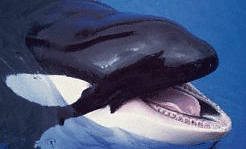 This
group includes Dolphins, Porpoises, Killer whales (Orcas) and
Sperm Whales. They have teeth in the usual manner, usually consisting
of lots of identical peg-like (but often very sharp!) teeth
to catch their slippery prey. Odontocetes are predators on fish
or other fast swimming and fairly large prey such as squid.
This
group includes Dolphins, Porpoises, Killer whales (Orcas) and
Sperm Whales. They have teeth in the usual manner, usually consisting
of lots of identical peg-like (but often very sharp!) teeth
to catch their slippery prey. Odontocetes are predators on fish
or other fast swimming and fairly large prey such as squid.
Toothed whales differ from baleen whales (and every other mammal) in that they only have one nostril instead of two. Orcas have teeth in both jaws like most Odontoceti, Sperm Whales are unusual in that they only have teeth in the lower jaw.
Baleen whales - Mysticeti
The members of this group don't have teeth as we know them, but baleen plates or "whalebone". The whole skull of such whales is highly modified. There is a large strong bony projection from the front of the "brain case" called the rostrum, from which baleen plates (made of keratin, like skin, fingernails, hair, hooves and rhino horns) hang on either side. This makes a triangular tent-like structure that is a large and elaborate sieve. The lower jaw is the "floor" of this tent and baleen whales have a huge tongue that sits in the middle of it all.
Mysticetes take in a mouth full of sea water and huge numbers of planktonic food such as krill or even shoaling fish They then close their mouths and use the tongue to push out all of the water through the baleen filters which keep the small prey inside, these are then swallowed. Different species of whales feed on different sizes of prey according to how wide the gaps in their baleen filters are. In this way, they don't all compete directly with each other and so are able to co-exist in the oceans occupying different "niches".

A Right Whale, a baleen whale, showing the baleen
in the mouth and the large tongue.
The baleen whales include all the really large whales apart from the Sperm Whale (which has teeth). Blue, Right, Sei, Fin, Grey, Humpback and Minke whales are all baleen whales.
Some whales are referred to as "Rorquals" These are members of a group of whales that are characterised by having numerous longitudinal grooves along the throat region, they also have short baleen plates, rarely more than 3 feet long and are the fastest swimming of the whales.
Taxonomy of whales
Taxonomy is the study of the relationships between organisms. It is a system of classifying them by observable structures that may be large, molecular or anywhere in between. Taxonomy groups organisms according to their similarities based on evolutionary relationships.
Whales are mammals of the order Cetacea:
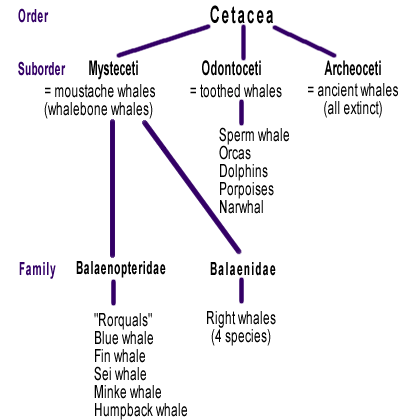
This is not a comprehensive summary of the taxonomy of all Cetaceans, but of those found commonly in Antarctica and covered in more detail on this site.